


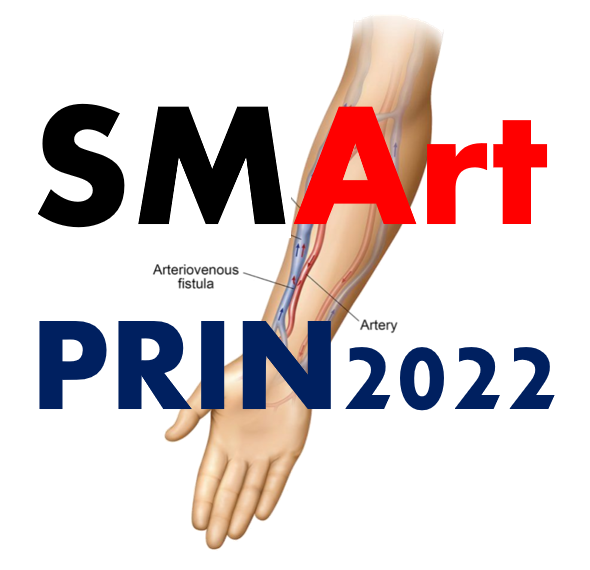
The project will provide a significant contribution in the advancement of scientific knowledge on the physiological and pathological
behavior of arteriovenous fistulas and their optimal management, based on early detection of dysfunctions development and timely
interventions to prevent unnecessary hospitalizations. The main contributions can be summarized as follows:
- Development of a methodology for unobtrusive, non-invasive, simultaneous recording of pulse, thrills, and bruit sounds of an
arteriovenous fistula from a patient’s forearm, which is currently not feasible with the methods and technologies presented in
literature; - Investigation on quantitative analysis of pulse and thrill of AVFs, which has never been reported in literature and could provide
additional insights into the physiological and pathological behavior of AVFs, as testified by the importance of physical assessment of
such clinical manifestations via palpation in routine patient visits; - Public availability of a large database of unprecedented patient data with recordings of pulse, thrill, and bruit sounds, along with
medical annotations and clinical parameters obtained via standard medical instrumentation, which will be unique to this project and
could foster future research on assessment and early diagnosis of AVF dysfunctions from data that could be acquired remotely and
frequently acquired from patients at home. - Definition and extraction of possible novel quantitative indices of AVF function, which could help to improve the capability of
recognizing the development of AVF dysfunctions at early stages.
Development of artificial intelligence approaches for medical decision support aimed at recognition, staging, and risk stratification
of patients with AVF dysfunctions, with the aim of sending early warnings and empowering the medical staff to perform timely
diagnosis of potential threatening conditions and to provide prompt intervention to prevent unnecessary hospitalizations.
The project will therefore contribute to advance the knowledge on the non-imaging diagnostics on arteriovenous fistulas. The
research activities that will be carried out within the project will inherently lead to a deeper comprehension of the pathological
origins of modifications observed in pulse, thrill and bruit sounds at the AVF site or along the vein. The project will also advance
knowledge on the design and implementation of novel signal processing and artificial intelligence approaches for the quantitative
assessment of an AVF function and the development of dysfunctions, thus promoting further research.
In addition, the use of the home-care surveillance system will generate large amounts of data from various patients. The public
availability of these large databases will provide new insights for research in the field of pathophysiology. Moreover, new information
and novel paradigms for medical data processing will likely emerge, which would feed the research in the fields of medicine and
biomedical engineering. As an example, by taking advantage of machine learning and deep learning strategies to analyze this large
amount of data, it would be possible to extract additional diagnostic information and long-term physiological trends.
The results obtained will support new approaches to patient care and management through the paradigm of personalized medicine.
The smart personal monitoring will provide an objective basis for differentiation between individuals or groups of individuals to adopt
different healthcare strategies and approaches, by tailoring prevention and therapy to the individual patient based on his predicted
response or risk of disease.
The results of this research project will also stimulate and provide the means for further investigation on various aspects of AVF
function and dysfunctions, e.g. by extracting quantitative indices also from measurements of pulse and thrill on AVF, which have not
been addressed yet in research.