


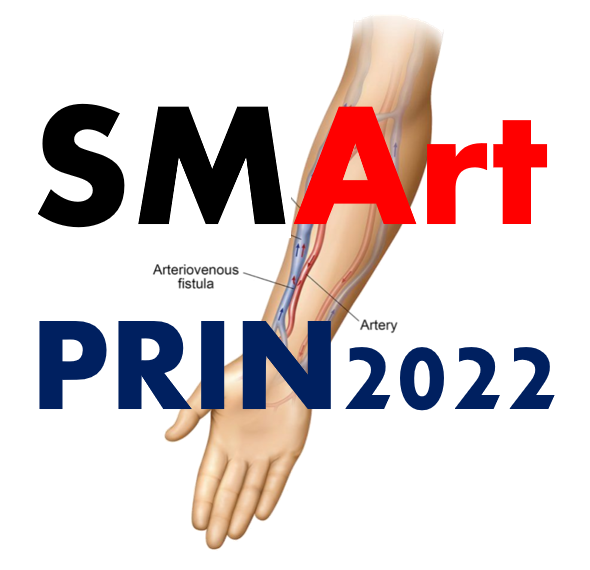
The project aims to design, develop, and test a new home-care surveillance system for arteriovenous fistula (AVF) in dialysis patients. A smartphone-based personal device will be developed to implement frequent monitoring of the patency and functionality of the AVF, so as to early recognize stenoses or threatening conditions. The personal device is intended to be used by the patient himself at home and will non-invasively capture the pulse, the thrill, and the bruit sounds from the fistula region. To date, no medical device, commercial or research, is available that can record all these signals. In this way, patient surveillance could avenue daily or weekly data and provide early indications about complications and allow prompt medical intervention. This would increase the quality of medical service provided and lead to a reduction in costs. Some concise, objective parameters will be computed, also via artificial intelligence and machine learning approaches, in order to recognize stenosis development and other complications at early stages, which would give the unique opportunity to prevent more serious complications that usually result in patients’ hospitalization, with aggravations on both patients' quality of life and costs to the national health care system. The successful implementation would promote patient empowerment and provide robust medical decision support to improve healthcare delivery services for dialysis patients.
The targets of the project are:
• Development of a new home-care surveillance system to improve the management of arteriovenous fistulas, by ensuring continuity of care at home to dialysis patients. The designed system will provide frequent, remote monitoring of a patient’s AVF function to enable early detection of ominous signs of AVF dysfunctions. This will support timely in-depth diagnoses and interventions that would prevent unnecessary hospitalizations, eventually improving patients’ quality of life and, at the same time, reducing the costs to the national healthcare system. Expected result: Setup of a new telemedicine paradigm for AVF patient surveillance and management.
• Design and prototyping of a smartphone-based personal sensing unit that allows patient themselves to simply acquire sounds and vibrations from the forearm skin in proximity of the fistula and along the vein. Expected result: smartphone-based personal sensing unit usable by patients.
• Objective recording of new type of AVF patient data (pulse, thrill, and sounds) currently not available because only sensed by palpation and auscultation. Creation of a database that includes the new data, properly annotated by expert medical staff, and the corresponding diagnostic tests such as Doppler ultrasonography and angiography, which objectively show the degree of stenoses, etc. Expected result: additional, quantitative diagnostic signals; innovative data-sets available on public repositories.
• Definition and extraction of relevant features from patient data to early recognize fistula complications. Correlation between features and degree of severity of fistula complications and faults. Development of an artificial intelligence system for enhanced evaluation of ominous signs. Expected result: new objective diagnostic features for AVF management.