The methodologies exploited for the implementation of the project are:
• Home-care telemedicine to improve patient management Use of telemedicine to receive diagnostic information taken at home by patients themselves to implement advanced surveillance of fistula function and patient management.
• AVF monitoring via body vibration sensors Employment of innovative body vibration sensors, recently patented by some researchers of the UNINA research unit. These sensors, once applied onto patients’ skin, will allow monitoring the tiny forces associated with both the infrasonic and acoustic vibrations produced by an AVF. An ad-hoc device for AVF monitoring will be developed based on this kind of sensors.
• Smartphone-based acquisition and processing of AVF data Use of a patient’s personal smartphone for AVF data acquisition, processing and transmission to the medical unit in charge of patient’s care. AVF data acquisition will be performed either directly via the smartphone microphone to capture bruit sounds, or by connecting to a dedicated measurement device featuring body vibration sensors, which will provide simultaneous recordings of pulse, thrills, and bruit sounds produced by the patient’s AVF.
• Collection of data from pre-dialysis and dialysis patient Collection of patients’ data via signal acquisition with the innovative Forcecardiography (FCG)-based sensor and the smartphone-embedded microphone, and via standard medical examinations with Doppler imaging and auscultation, which will be performed simultaneously. The data that will be acquired and properly annotated by the medical staff are currently not available on conventional databases of biosignals, and will be unique to this research project.
• Quantitative data analysis Extraction of quantitative indices of AVF functional status, either conventional or novel, from the pulse, thrill, and bruit sounds recordings obtained via the FCG-based sensor. These indices will help clinicians to monitor the course of an AVF remotely and more frequently, so as to support early diagnosis of potential threatening conditions and timely intervention.
• Advanced signal processing and Artificial Intelligence Advanced processing and analysis of AVF data to support medical decision by providing high-level suggestions and early warnings about potential alterations of AVF health conditions (e.g., development of a stenosis at early stages), which will help clinicians to pay attention to latent pathological cases, and intervene more promptly to remedy or even prevent possible adverse events.




Empty Banner
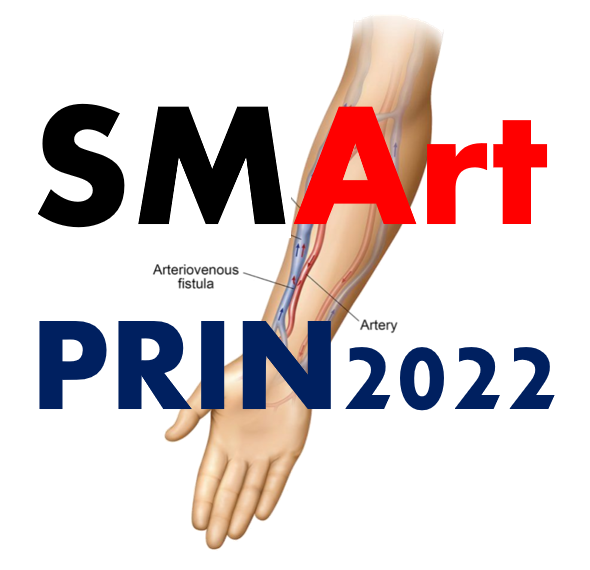
SMArt - Self-monitoring system for Arteriovenous fistula
Università degli Studi
della Campania
Luigi Vanvitelli
Università degli Studi
di Napoli
Federico II

Università degli Studi
di Salerno

Privacy
Follow Us


Contacts
Via Leonardo Bianchi c/o Ospedale Monaldi
80131 - NAPOLI
prinsmart@unina.it