


Brief description
The arteriovenous fistula (AVF) is the preferred vascular access for hemodialysis in end-stage kidney disease patients. AVF management is essential for a successful dialysis treatment and can influence long-term patient survival. Physical examination is the first step to diagnose AVF malfunctions, while in-depth investigations, e.g. via Doppler ultrasound are carried out if necessary. Physical examination includes palpation of AVF thrill and auscultation of bruit sounds at AVF site. Guidelines recommend frequent periodic patient visits. This requires a large deployment of financial resources and specialized personnel. A tele-monitoring system can provide more effective and efficient patient surveillance.The research project is based on an interdisciplinary collaboration of medical and engineering research units with the aim of developing a prototype surveillance system that allows patients to record and transmit AVF pulse, thrills, and bruit sounds via their smartphone, together with additional clinical indices and early warnings, to provide physicians with an advanced support for AVF patients surveillance. A novel measurement device will be developed for non-invasive recording of AVF infrasonic and acoustic vibrations. Advanced data processing and analysis methods, also powered by artificial intelligence, will be developed to provide quantitative indices of AVF function and support early detection of complications. The prototype system will be validated on a consistent number of pre-dialysis patients at different stages of AVF maturation and later on dialysis patients, too. Key innovations are:- Novel methodology for non-invasive, simultaneous recording of AVF pulse, thrills, and bruit sounds via innovative body vibrations sensors, recently patented by some project participants. Currently, no methodology has been proposed in literature for recording and quantitative analysis of AVF pulse and thrills aimed at diagnosis of AVF dysfunctions.- Large public database of unprecedented patient data, including AVF pulse, thrills, and bruit sounds, medical annotations, and clinical parameters, which is currently not available.- Medical decision support for early detection, staging, and risk stratification of patients with AVF dysfunctions (e.g. stenoses), powered by Artificial Intelligence.- Home-care telemedicine system for enhanced dialysis patient surveillance. The expected outcomes of the project are manifold and include the development of new and objective indicators of fistula patency and function, an alert system for early detection of dysfunctions, more intensive surveillance, and promotion of patient empowerment. Practical implications of the project include early detection of AVF complications, which allows timely intervention and prevention of unnecessary hospitalizations, with reduction of healthcare costs and improvement of patients’ quality of life.
STATE OF THE ART
End-stage kidney disease (ESKD), defined as the last stage of Chronic Kidney Disease (CKD), is a rapidly increasing worldwide health and health-care burden. Patients with ESKD have significantly higher risk of morbidity and mortality due to multiple comorbidities. Renal supportive therapy (conventional hemodialysis, peritoneal dialysis and home hemodialysis) is life- sustaining treatment available to support existing renal function in patients during progression to ESKD and/or renal transplantation. The International Society of Nephrology’s (ISN) in 2019 reported treated incidence of ESKD worldwide, as new cases diagnosed, was 144 individuals per million general population. A survey conducted by the Italian Society of Nephrology (SIN) highlighted that the prevalence of ESKD is of 7% of the Italian population but reaches values up to 50 % in the presence of diabetes, arterial hypertension, obesity and dyslipidemia. For years, the quality of medical care of ESKD has been a concern. Hemodialysis has a major impact on the life of the patient and his family and entails significant social costs. Vascular access for CKD patients with regards to the arteriovenous fistula (AVF) for hemodialysis is an essential part of kidney replacement therapy. However, the surgical technique and the follow-up monitoring system have remained unchanged for decades. The high morbidity and mortality associated with current vascular access complications highlight an unmet clinical need for novel techniques in vascular access and are driving innovation in vascular access care. The development of devices, biological approaches and novel access techniques has led to new approaches to control fistula and influence its maturation and formation through the use of external mechanical methods. Follow-up of patients with arteriovenous fistula involves periodic visits to health care facilities. More frequent check-ups could help with early diagnosis of occlusion or partial stenosis. The initial physical examination simply consists of palpation and auscultation onto and nearby the fistula and it can nearly always detect common problems. Various innovative techniques or devices have recently been proposed as diagnostic aids. Most of these are based on acquiring the bruit sounds, e.g. using electronic stethoscopes, and processing them. These techniques aim to provide an effective support to clinicians for improving arteriovenous fistula management. Some concise parameters of the bruit sounds, such as pitch shift and spectral spreading can generate early warning and trigger more specific and expensive diagnostic procedures as ultrasound and invasive radiological angiography. Most studies have shown that the frequency spectrum of the bruit sounds of vein blood flow spreads to higher frequency when the vein becomes stenotic. Some studies have also attempted to establish a correspondence between the change in sound frequency and the extent of stenosis (percentage of residual lumen). Various algorithms for extracting specific synthetic parameters in both time and frequency domains are reported in the literature; there have been some attempts to use methods such as machine learning and artificial intelligence to improve the sensitivity and specificity of stenosis recognition. Typically, electronic stethoscopes are used to acquire and record sounds. Microphone sensors have also been proposed to replace stethoscopes. One research group has also proposed an array of microphone sensors to pick up sounds on a large arm surface. The spectrum of sound changes significantly in the vicinity of the stenosis itself, but it is perceived over a wide area of the arm with different amplitudes. The research project aims to develop and validate a homecare tele-monitoring system for the AVF patients. The system involves capturing pulse, thrills, and bruit sounds by the patient himself via a smartphone, processing the recordings and transmitting data to physicians. This would support patient surveillance, both in the post-surgical period and during follow-up, to prevent complications that may occur during the lifetime of the vascular access and to diagnose adverse events at early stages.
OBJECTIVES
Early clinical and organizational management of vascular access for hemodialysis patients is essential in a modern and ''economic'' vision of medical care. The widespread use of the Doppler ultrasound (DUS) by the nephrologist has increased the number of patients who are eligible for arterio-venous fistula (AVF); indeed, DUS exam is essential for the preoperative vascular mapping to facilitate the identification of vessels that are suitable for fistula construction. In addition, DUS examination is also one of the most used methods for the surveillance of AVF (post-operative surveillance) but it is time-consuming and requires an expert operator. To avoid such time consumption and to obviate the presence of an expert operator, a self-monitoring system, used by the patient himself, could be applied for AVF surveillance by improving the early detection of fistula complications. Such system should provide a functional data of warning. To our knowledge, there is no medical, commercial or research device available that can record all available signals of AVF dysfunction.
The project aims to design, develop, and test a new home-care surveillance system for arteriovenous fistula (AVF) in dialysis patients. A smartphone-based personal device will be developed to implement frequent monitoring of the patency and functionality of the AVF, so as to early recognize stenoses or threatening conditions. The personal device is intended to be used by the patient himself at home and will non-invasively capture the pulse, the thrill, and the bruit sounds from the fistula region. To date, no medical device, commercial or research, is available that can record all these signals. In this way, patient surveillance could avenue daily or weekly data and provide early indications about complications and allow prompt medical intervention. This would increase the quality of medical service provided and lead to a reduction in costs. Some concise, objective parameters will be computed, also via artificial intelligence and machine learning approaches, in order to recognize stenosis development and other complications at early stages, which would give the unique opportunity to prevent more serious complications that usually result in patients’ hospitalization, with aggravations on both patients' quality of life and costs to the national health care system. The successful implementation would promote patient empowerment and provide robust medical decision support to improve healthcare delivery services for dialysis patients.
The objectives of the project are:
• Development of a new home-care surveillance system to improve the management of arteriovenous fistulas, by ensuring continuity of care at home to dialysis patients. The designed system will provide frequent, remote monitoring of a patient’s AVF function to enable early detection of ominous signs of AVF dysfunctions. This will support timely in-depth diagnoses and interventions that would prevent unnecessary hospitalizations, eventually improving patients’ quality of life and, at the same time, reducing the costs to the national healthcare system. Expected result: Setup of a new telemedicine paradigm for AVF patient surveillance and management.
• Design and prototyping of a smartphone-based personal sensing unit that allows patient themselves to simply acquire sounds and vibrations from the forearm skin in proximity of the fistula and along the vein. Expected result: smartphone-based personal sensing unit usable by patients.
• Objective recording of new type of AVF patient data (pulse, thrill, and sounds) currently not available because only sensed by palpation and auscultation. Creation of a database that includes the new data, properly annotated by expert medical staff, and the corresponding diagnostic tests such as Doppler ultrasonography and angiography, which objectively show the degree of stenoses, etc. Expected result: additional, quantitative diagnostic signals; innovative data-sets available on public repositories.
• Definition and extraction of relevant features from patient data to early recognize fistula complications. Correlation between features and degree of severity of fistula complications and faults. Development of an artificial intelligence system for enhanced evaluation of ominous signs. Expected result: new objective diagnostic features for AVF management.
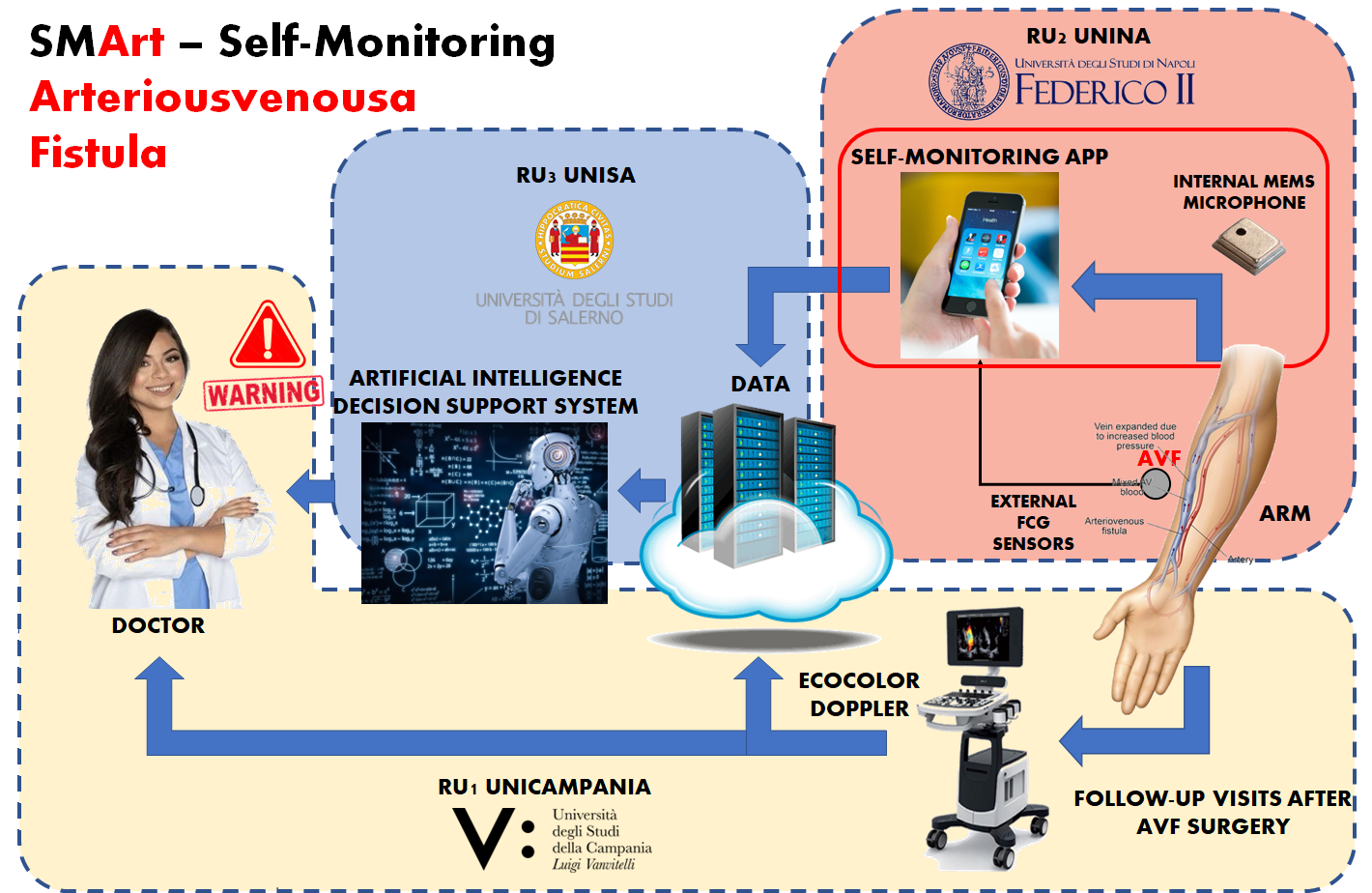
In the following figure, a conceptual scheme of the SMART project with the different areas of competence for each research unit is shown.
METHODOLOGIES
The methodologies exploited for the implementation of the project are:
• Home-care telemedicine to improve patient management Use of telemedicine to receive diagnostic information taken at home by patients themselves to implement advanced surveillance of fistula function and patient management.
• AVF monitoring via body vibration sensors Employment of innovative body vibration sensors, recently patented by some researchers of the UNINA research unit. These sensors, once applied onto patients’ skin, will allow monitoring the tiny forces associated with both the infrasonic and acoustic vibrations produced by an AVF. An ad-hoc device for AVF monitoring will be developed based on this kind of sensors.
• Smartphone-based acquisition and processing of AVF data Use of a patient’s personal smartphone for AVF data acquisition, processing and transmission to the medical unit in charge of patient’s care. AVF data acquisition will be performed either directly via the smartphone microphone to capture bruit sounds, or by connecting to a dedicated measurement device featuring body vibration sensors, which will provide simultaneous recordings of pulse, thrills, and bruit sounds produced by the patient’s AVF.
• Collection of data from pre-dialysis and dialysis patient Collection of patients’ data via signal acquisition with the innovative Forcecardiography (FCG)-based sensor and the smartphone-embedded microphone, and via standard medical examinations with Doppler imaging and auscultation, which will be performed simultaneously. The data that will be acquired and properly annotated by the medical staff are currently not available on conventional databases of biosignals, and will be unique to this research project.
• Quantitative data analysis Extraction of quantitative indices of AVF functional status, either conventional or novel, from the pulse, thrill, and bruit sounds recordings obtained via the FCG-based sensor. These indices will help clinicians to monitor the course of an AVF remotely and more frequently, so as to support early diagnosis of potential threatening conditions and timely intervention.
• Advanced signal processing and Artificial Intelligence Advanced processing and analysis of AVF data to support medical decision by providing high-level suggestions and early warnings about potential alterations of AVF health conditions (e.g., development of a stenosis at early stages), which will help clinicians to pay attention to latent pathological cases, and intervene more promptly to remedy or even prevent possible adverse events.
More details on the methodologies are given below.
Home-care telemedicine to improve patient management Telemedicine has emerged as an advantageous innovation in health service delivery. Considerable benefits have been achieved both for health services in rural and/or isolated areas and for the management of chronic patients. Telemedicine can provide better access to healthcare services, increase patient's quality of life and, at the same time, provide more effective prevention and treatment and reduce healthcare system costs. In particular, home care has proven to be particularly useful in monitoring chronic patients more assiduously for early prevention of worsening of disease or decompensation and thus avoiding costly and demanding hospitalizations. Homecare can offer valuable and better support to the disease management process, supplementing conventional delivery techniques. Expected benefits include availability of more objective data for personalized care, noticing complications earlier, optimizing the number of hospital visits, decreasing the number of hospitalizations, reducing costs, patient empowerment, increasing patient quality of life, etc.
Collection of data from human subjects
The uniqueness of the patient data that this project aims to leverage to achieve accurate quantitative monitoring of AVF, makes existing public databases unsuitable for this purpose and calls for an intensive measurement campaign to be carried out within the project. To this aim, the project will rely on the contribution of the medical unit (Nephrology Center of Vanvitelli University), which has a great expertise in the management of arteriovenous fistulas, as well as a large number of patients being treated and a large database of dialysis patients data. The UNICAMPANIA unit will be responsible for the enrollment of at least 100 patients divided in AVFs in pre-dialysis stage, and undergoing dialysis therapy. The unit will give support for data collection and annotation. The resulting unique, large database will be made available on public repositories.
Advanced signal processing and Artificial Intelligence
In the last decades, the advancements in artificial intelligence (AI) methods have demonstrated the potential of AI in providing valuable medical decision support, by fusing various kinds of physiological parameters to accomplish sophisticated tasks, such as detecting events, recognizing conditions and even predicting trends and outcomes. These high-level analytical capabilities perfectly fit the problems of prevention, diagnosis and follow-up of arteriovenous fistulas. Indeed, AI could be used to design more sophisticated and performing methods to recognize early, ominous signs of health degenerations in patients with AVF, such as the development of stenoses, in order to improve their management and prevent hospitalizations, which worsen patients’ quality of life and increase the costs to the national healthcare system. The early phases of the project will set the perfect condition for the design of AI strategies by providing a large dataset of annotated biosignals, namely the pulse, thrills, and bruit sounds recordings acquired via the body vibrations sensors and the patients’ smartphones during the first measurement campaign of the project. The dataset will be exploited on one hand to carry out an investigation on the correlation between the features of the recorded sensor signals and fistula functionality indices, and on the other hand to train an artificial intelligence system that provides suggestion about the development of possible AVF dysfunctions.