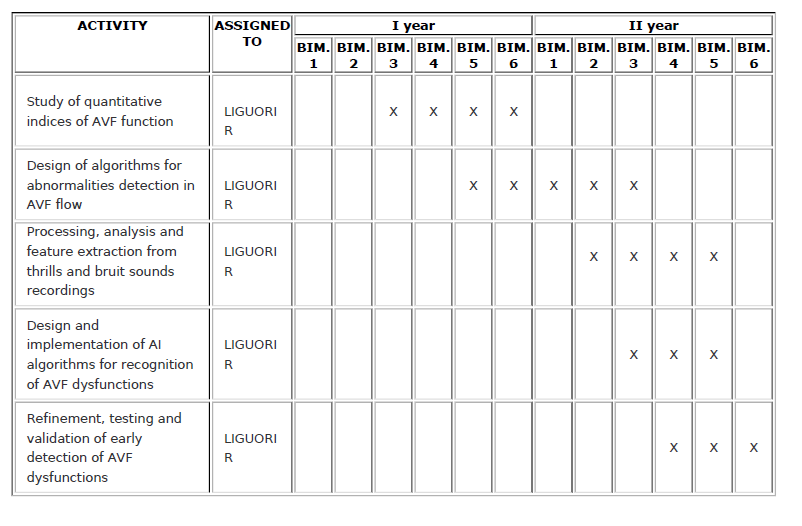


WP5 (UNISA) [months 5-24] – Processing and analysis of patient data
This WP is dedicated to processing data taken from AVF patients and extracting significant parameters for early recognition of fistulaco mplications. Various parameters will be extracted from the patient signal such as the amplitude or intensity of the sphygmic wave, the frequency and amplitude and waveform of the thrill, the frequency contents of the bruit sounds.
The site of signal retrieval,distance from the fistula, etc. will also be taken into account in the processing. The extracted indices will be compared and correlated with clinical findings and objective measurements such as vein diameter, blood flows, blood pressure, site of possible stenosis, percentage of occlusion of the vessel lumen, etc. Advanced signal processing algorithms will be used both to extract other signal properties and to discover correlation of certain parameters with the functional status of the fistula. In addition to traditional techniques, modern artificial intelligence and machine learning (ML) technologies will be used for the effective monitoring of AVF functionalities and the automated classification of sensor-produced signals into various AVF risk classes. In particular,
Neural-network models, such as Convolutional Neural Network and Auto-Encoders on which UNISA team boasts a strong experience, will be investigated and compared with the traditional ML-based approaches, such as Decision Tree, k-Nearest Neighbors, Support Vector Machine, Artificial Neural Network (ANN), with the aim of meeting the requirements of a reliable monitoring system, that is,
exploiting standardized diagnostic thresholds and guaranteeing adequate detection sensitivity, specificity and accuracy. Custom ANN models will be adapted or, eventually, designed with the aim to obtain state-of-the-art prediction and classification capabilities. Obtained models will be profiled to derive their computational complexity and to determine the right implementation platform.
Exploiting the skills of the UNISA unit, custom hardware designs of the ANNs will be implemented on FPGA platforms to evaluate their power and area performance. Finally, custom integrated circuits will be synthesized with commercially available tool chain to profile the state-of-the-art performance of the designed system. Training datasets will be derived during the first phase of the
project, based on free available data and data available to the other Units. At the end of the project, It is expected that such data processing will provide additional diagnostic information that will enable physicians to predict various complications of fistula function in advance. This activity will be carried out by the UNISA unit in collaboration with the other units. The technical report on
processing and analysis of patient data is the deliverable D4 of the project.